
COP17 discussions highlight the need to protect Southeast Asia’s marine ecosystems, uphold Indigenous Peoples’ rights, and defend Palawan and the Verde Island Passage from growing development pressures.
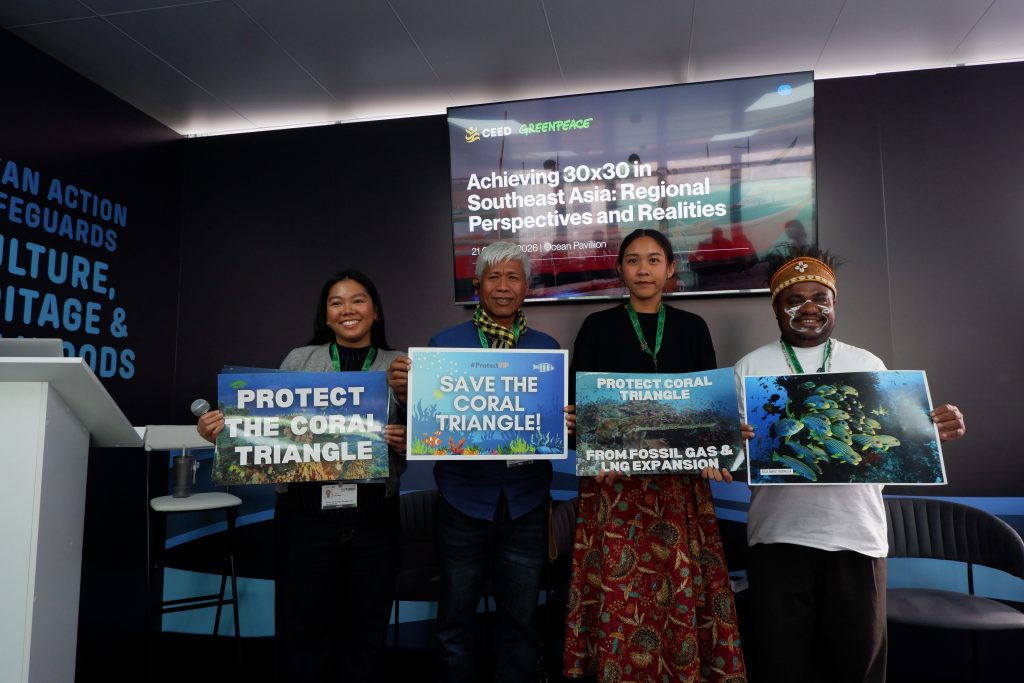
YEREVAN, ARMENIA — Environmental leaders and civil society are calling to accelerate concrete, equitable actions to protect the region’s marine ecosystems, emphasizing that achieving the global 30×30 target requires more than designating protected areas. It demands the recognition of Indigenous Peoples’ rights and knowledge, the leadership of local communities, and halting biodiversity loss from industrial activities that threaten the region’s extraordinary biodiversity.
The call comes following two discussions at the 17th Conference of the Parties to the Convention on Biological Diversity (CBD COP17) in Yerevan, Armenia, on October 21. The sessions examined how Southeast Asian countries can translate global biodiversity commitments into lasting protection for marine ecosystems, with particular attention to the Coral Triangle and the Verde Island Passage (VIP) in the Philippines.
“Achieving 30×30 cannot just be about drawing boundaries on a map. It must recognize the rights, knowledge, and leadership of Indigenous Peoples and local communities, who are among the most important guardians of our forests, seas, and biodiversity. Conservation must be equitable, community-led, and backed by real action to address the threats facing these ecosystems,” said Anj Dacanay, lead campaigner at Energy Shift Southeast Asia.
Established under the Kunming-Montreal Global Biodiversity Framework (KMGBF), the global 30×30 target aims to conserve at least 30% of the world’s land, inland waters, coastal areas, and oceans by 2030. For Southeast Asia, one of the world’s most biologically rich regions, meeting this commitment is critical to safeguarding marine life, food security, coastal livelihoods, and the resilience of communities facing climate change.
However, a central theme of the discussions was the contradiction between conservation goals and growing development pressures from fossil fuel expansion. According to recent spatial analysis by Earth Insight, 12% of Southeast Asia’s existing marine protected areas and 12% of its unprotected Key Biodiversity Areas (KBAs) – overlap directly with oil and gas blocks.
“We need to close the gap between international commitments and what is actually happening on the ground. Protecting nature while allowing fossil fuel development and extractive industries to threaten the same ecosystems that sustain our communities across Southeast Asia deserve a paradigm shift in how we look at the real-world problems today,” added Dacanay.
Turning the spotlight to localized threats, discussions focused on Palawan, often called the Philippines’ last ecological frontier where expansion of oil and gas exploration and development is happening.
Home to two UNESCO World Heritage Sites, Palawan boasts interconnected ecosystems that sustain fisheries, eco-tourism, food security, and Indigenous livelihoods. Its forests, mangroves, coral reefs, seagrass beds, and watersheds also help communities withstand climate impacts.
Despite its ecological importance, petroleum service contracts and plans for further fossil fuel development raise concerns about the cumulative effects of offshore extraction and related infrastructure on marine ecosystems, protected areas, ancestral territories, and traditional fishing grounds.
“Palawan shows why we cannot separate biodiversity protection from decisions about energy and industrial development. We cannot commit to protecting 30% of our lands and oceans while expanding fossil fuel activities that put sensitive ecosystems and the communities depending on them at risk,” Dacanay said.